I’ve just taken delivery of a new Lowrance Link-2 DSC radio to replace my ageing ICOM M33. It’s currently charging and I’ll be having a good play with it over the next few days. The biggest difference when compared to the ICOM is the addition of a GPS receiver and DSC, yet its weight is exactly the same. I’ll be posting a detailed initial review very soon!

Showing posts with label VHF Radio. Show all posts
Showing posts with label VHF Radio. Show all posts

A tale of woe !
I'd been out fishing at the Bristol Channel for about three hours, anchored up off a reef. The wind freshened up into a easterly with a steady swell rolling down the Channel, nothing of interest. I'd noticed a couple of rogue waves come down from the north, hitting the kayak side on and filling a foot well. Again, nothing of interest nor concern.
During slack water I was a bit bored and started nosing around. I went to open the front hatch and to my horror noticed a 2" split along a seam on the inside thigh of my dry suit. On close inspection it was running along a line where there was a taped seam underneath. It was a straight tear, slightly frayed, so not a cut. It almost looked like a fatigue crack. I inspect my suit every other trip so it really took me by surprise. I actually took a photo which is further down this post..
So, I'd already been out three hours, the kayak was stable in the tide, lying with the swell, things couldn't have been better. I decided to fish another hour or so as planned then head back in. I was taking a few photos and leaned slight to the left with the camera down the side of the kayak. Whilst taking a few photos the whole kayak tipped up, I was already slightly to one side and the sudden change of angle was enough to put me off balance. Before I could react it continued to roll and I capsized... no doubt one of those rogue waves from the north. No biggie, it happens to us all eventually and we prepare for this. My first capsize in over 200 trips, I couldn't complain!.
The kayak had flipped but it was quickly turned right side up at the second attempt. Though with the kayak anchored and the tide beginning to ebb, and with a running sea, I was getting pushed down the kayak as I tried to re-enter. No big deal, I went around the kayak and disconnected the anchor and drifted. That changed everything and I went to re-enter. I was lying over the kayak and was just about to turn into the seat when a swell hit the kayak and I slid off. Oh well, so I went to get back on again though I failed to get quite as far. Each attempt saw me struggle that little bit more. Odd, I wasn't tired.... that's when I remembered the rip in my dry suit, my suit was full from the waist down.
I tried a few more times though I was just wasting energy and flipped the kayak a couple of times. There was a charter boat a mile west of me so I called him up on the radio, no response. I was about 500m offshore, I briefly considered kicking for the shore, but I'm also aware that the tide runs away from the shore on the ebb heading directly to a headland 2-3 miles away. By this time I'd been in the water around 15 minutes and was steadily drifting east. Water temp was 12 degrees centigrade.
Leaving the kayak would have been stupid , it's a huge life raft after all, so I decided to give the coastguard a shout. We chatted and I explained my position, gave him my GPS co-ords and waited. I watched a coastguard wagon come along the cliff top and he was struggling to see me, so I directed him verbally to my area, switching on the navigation light helped no end ;D
The coastguard called up and told me it'd be 15 minutes until the lifeboat was on scene, no biggie, I was very warm. They turned up and at first suggested they'd help me back onto the kayak, though with a full dry suit it wasn't happening. With two guys helping, and me pulling, I was hauled aboard the lifeboat. Standing up was amusing, my legs were like the Michelin man with water gushing out of the tear. Slightly worrying was the presence of three small pinholes in the other leg with small jets of water squirting out. The later a put down to being pricked with hooks over the past 4 years (that turned out no to be the case - more later).
They were extremely impressed with the array of safety gear and that all precautions had been taken. I had been asked to let of smoke/flare if they'd asked. Though with a visual from the shore and my GPS position they came straight to me without any drama.
With a dry suit full of water making a successful re-entry would have been quite a feat for anybody, I certainly found it impossible once my suit had filled up. After 35 minutes in the water I was still wonderfully warm and could have stayed in there for rather a long time if required. I still had a mobile phone in a dry box which I could have used if a radio call had been unsuccessful.
As much as we prepare for the worst day, what with capsize drills and carrying an assortment of safety gear, we cannot prepare for every eventuality. Ultimately we carry a radio to make that call when all else fails. Despite my best preparations, I was forced into making that call today.
Yes, I could have deserted the kayak, made for shore and perhaps saved the call. Though I could also have got into difficulties and finding me would have been made much more difficult. Sure, it's a little embarrassing, though I'm happy that I was suitably prepared, on the day I was just plain unlucky. Spotting the rip in my dry suit was one nasty surprise, falling off on that very same trip (after 200+ dry trips) was another!
Many thanks to the RNLI and the Coastguard who have been suitably thanked and rewarded by myself. Oh, and what did a lose?. A bottle of coke (well 1/2 a bottle) and one glove.
Here's a follow up to this initial report:
As I'd mentioned earlier I noticed the tear in my dry suit well into the trip, I was that amazed I took a photo!

On closer inspection with the suit washed and dried this is what I saw. I've lifted the torn portion so it's more visible.

The suit material had weakened along the taped seam, probably by chafing whilst walking or general movement on the kayak. As it had flexed along the length of the seam it had weakened through fatigue, some areas saw signs of external wear.
Looking at the same area on the opposite leg exactly the same problem was present. It's not something you'd notice because as the suit has aged the taped seams have become more visible. Hence an area of wear along a line is in fact very difficult to spot.

The other leg had already holed in the same area, the hole was less than 1mm, though the fabric was weakened along the line close to it. I've macro'd in close, unless your inches from the damage you'd never notice it.
I went over the suit with a VERY close eye and more areas of damage became apparent. A very small hole was present along an area of slight wear, the wear line was an inch at most.

Again on the inside of the leg, a fussy join exists and the material is slightly rucked my the stitching. The whole length of this is around 1cm. A small hole around 1mm had formed where the material was raised by some stitching and had worn through.

The same area on the opposite leg was showing similar wear though had not worn through.

One final hole was found in the crotch area, again a very small length of wear, under an inch, though a tiny hole had formed.

So there were four pinholes in my suit due to wear. They were all in areas you'd never notice and probably not really think to look. The worst area of wear had of course ripped. I'd not noticed it the previous 2 days, and with is close proximity to the centre hatch it was something that was easily spotted, so it's fair to assume the suit ripped on the day I noticed it.
So, there I was sitting comfy in a steady rolling swell getting soaked in the rain. The camera is low here though the swell was at most 3'

Looking at the camera memory card I'd taken several photos in the minute before I was tipped over. I was holding the camera when I capsized and apparently hit the shutter release a split second before I actually went under!. The kayak is at a 90 degree angle here, the rod holder is almost horizontal.

Never let a bad situation stop you taking an interesting photo

I capsized at 1428, the time was recorded on the photo. According the GPS I unclipped the anchor at 1430 and began to drift at an average on 1.1mph, bearing 285 degrees.
The RNLI picked me out at 1458 after a drift of just over 0.5 miles, they then headed for the Blue Anchor slipway. I'd been in the water 30 minutes, not the 35 minutes I'd thought. The black is my track out, the blue my drift post capsize and the yellow is the RNLI track to the slipway.

I was warm throughout, surprisingly warm and could have stayed in the water for a long time. Despite the damage to my suit my multiple layers of thermal clothing served me well. They did waterlog heavily and weighed a LOT once removed. However, the plan is not to get them wet in the first place !
The suit was 4 years old and had covered 200+ trips on the water. On inspection the suit was good condition and well maintained with new seals (talc'd after each trip), lube'd zippers, etc. However, if you looked VERY closely in areas that don't jump out, i.e high up on the inner thighs, crotch, etc, damaged had occurred, sufficient enough the cause the fabric to rip with little effort. You could lay that suit on the floor and check out the front, flip it, and check out the back, no damage whatsoever is visible. Yet it is worn and damaged, though it takes a VERY close and purposeful look to spot it.
So the lesson is don't just give your suit a cursory glance over post every trip, get up close and personal and give your suit a VERY close check-up, you may get a nasty shock!
Here's a link the the RNLI report, not totally correct, though close enough.
RNLI Report
Review - ICOM IC-M33 VHF Radio
About 3 months ago I finally took the plunge and purchased a handheld VHF radio. There's plenty on the market covering the price range of around £30-200, so the question was what to buy ?.
As a saltwater kayak fisherman there were a few requirements:
As a saltwater kayak fisherman there were a few requirements:
- Simple to use
- Corrosion resistant
- Waterproof (not just splash proof)
- Floating
- Decent battery life

The unit is quite compact measuring in at 62 x 141 x 43mm, weighing in at 300g.
The transmit power is more than adequate at 5W (High), 1W (Low). I've carried out radio checks with the coastguard at a range of up to 7 miles without a problem, this was actually better than I'd expected, the general rule being 1W per mile.

The unit is somewhat rounded in shape making it quite comfortable to hold. As well as the large display on the front panel there's also 9 large buttons that provide simple straightforward operation. There's quick access to channel 16 as well as simple control of the volume and squelch functions.There's Dual/Tri-watch functions, the latter being my favourite as it allow me to monitor channel 16, the coastguard on channel 67 as well as my call channel for that particular day. The standard scan function allows 'tagged' channels to be monitored, handy for keeping up on the local fishing chatter.
The unit can be easily switched between International and American channel frequencies should the need ever arise.
The antenna is a detachable flexible item, not easily damaged.

There is the facility to 'tag' your favourite channels making accessing or scanning them straight forward.
The display is quite large, measuring 32 x 16 mm
The display features a clear 2-digit channel number indication. The volume and squelch levels are shown in the display. LCD and key back lighting are standard features, ideal for night time operation. The battery life is also displayed in a clear 4 step indication.
Should the speaker or microphone become clogged with water, it can be cleared using the 'AquaQuake' draining function. This is activated by pressing the Scan and H/L buttons simultaneously, resulting in a vibrating sound that clears water away from the speaker grill.

The top on the unit houses the antenna, the ON/OFF switch and an optional speaker/microphone connector, the latter having no real use on a kayak.
The battery supplied with the radio is a Li-Ion battery proving approximately 9 hours of operating time, from the following ratio of usage: Tx (Hi): Rx: standby = 5:5:90. I've easily achieved 8 hours of usage with plenty of battery life remaining.

The battery is released from the base of the unit with the aid of a penny coin or the like. There's no real requirement to release the battery as the complete unit can be placed on the supplied charger, the only requirement being that the radio is switched off during charging.

My unit came with an optional alkaline battery holder allowing AA alkaline cells to be used in lieu of the Li-Ion battery. There's also an optional belt clip which affixes to the rear of the unit to allow external attachment to a PFD, etc. I've not utilised this item as it makes the unit a little to bulky to fit within my PFD pocket.

One reason I purchased the M33 was the claim that it floats, an important factor when kayak fishing!. It's something that hopefully wont happen for real, though just to check that it actually lived up to the hype, here it is floating away.
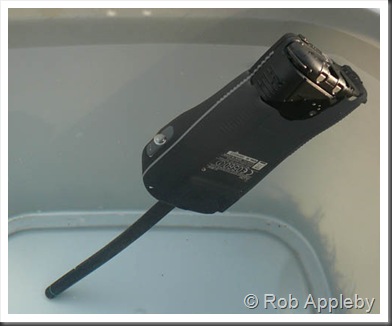


After three months of regular use it's still looking as good as new, a fresh water rinse post each trip no doubt aiding this. It's certainly a nice to have piece of kit, I don't consider it essential, I managed for over a year with a mobile phone kept in an Aquapak. However it is no doubt far superior in both it's abilities at communication, survivability in the marine environment, as well as ease of operation in an emergency situation.
If money hadn't been a consideration I would have pondered the Standard Horizon HX850S with DSC. Though for the distances I tend to fish, within 2 miles of the shore, I'm not convinced that I can justify the DSC functionality, as excellent as it is.
To gain a VHF license, a legal requirement to use a VHF radio, you are required to attend a one day 'Short Wave' radio course. The average cost, including the licensing fee, amounts to about £120.
To summarise, a worthwhile enhancement to safety and basic communications, and a quality piece of kit at an affordable price.
Please feel free to comment.
Subscribe to:
Comments (Atom)