For those regular readers of my blog it’s clearly no secret that I’m not particularly experienced when it comes to freshwater fishing. I’ve had a dabble in the past few months whilst fishing in Florida and Texas, however, both of those venue saw me targeting Largemouth Bass. My exposure to UK freshwater species was, until last week, nil!.
I’d recently entered myself into a competition fishing for mixed species at Llangorse Lake, located in the Brecon Beacons National Park, South Wales. Target fish were pike, perch, roach, bream and gudgeon.

Llangorse Lake is probably better known for its Pike fishing and to be perfectly honest, despite the competition being aimed at multiple species, I was planning of focussing my efforts on catching a pike. My knowledge of pike fishing is minimal to say the least. I’ve watched a few pike orientated fishing programs on television, though I purchased a couple of books dedicated to this particular discipline in order to gain a better overview and to hopefully provide me with some useful hints and tips!.
It’s quite overwhelming once you realise just how involved pike fishing actually can be. Sure, you can lure fish, float fish, livebait, deadbait, fly fish, etc, though it’s when you look closely at any one particular aspect, let’s say float fishing, that you begin to realise just how complex it potentially is!. Roving livebait, drifter float, trolling rig, loaded lift, laying on…… yup, there’s a lot more to it that just ‘float fishing’.
The plan was to keep it simple, taking on too much was only going to over-complicate things and undoubtedly detract from the overall experience. The initial plan was to take a selection of lures, some deadbait and the livewell. In principle it sounded straightforward enough, however, nothing is ever that simple!. I pulled out a few boxes of lures from my fishing cupboard and immediately started to scratch my head.

I also had a couple of carrier bags full of soft lures from the US and several more boxes up in the attic, crazy I know!. Several hours were spent chatting on a couple of lure fishing forums and reading various online articles. I ended up taking three small Plano boxes of lures, I know it was an overkill, though this was a fact finding mission of sorts, for future trips I’d certainly look to take less.
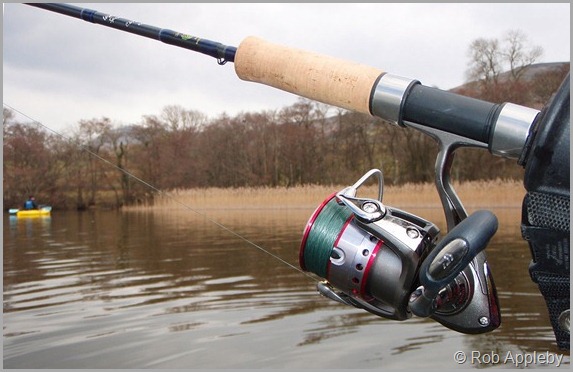
I’d purchased a few ready made dead baiting rigs, semi-barbless size 6 rigs which seemed to be a good all round size. I already had a selection of metal spinning traces so I was pretty much sorted with regards to end tackle. I added a pair of heavy duty forceps and a treble hook disgorger to my arsenal of tackle just to ensure that unhooking wasn’t going to prove too difficult. Rod and reel wise I took the same outfits that I used in Texas last year, namely two Daiwa 7’ medium spinning rods and 3000 sized reels loaded with 30lb braid.

With only some deadbait and maggots left to purchase, that was the fishing tackle side of things taken care of. Accommodation for the two nights was a tent, yup, I was camping. The UK is currently experiencing the coldest March is 50 years, with temperatures for the month averaging just above freezing, at times well below!. Perhaps the weather wasn’t ideally suited to camping, however, I have a good collection of ‘Artic’ gear from an earlier trip above the Artic Circle so I wasn’t overly concerned.
I was all packed and ready to depart by Thursday lunchtime, planning to return on Saturday evening. The last job was to load a fresh set of maps onto my handheld GPS. I’d decided to load all the Mapsource charts for the UK, this consisted of street maps (Navigator), Bluecharts and Topography maps. This is around 1800 detailed maps in total and takes approximately 3 hours to fully load. It was around 2 hours 40 minutes into the process when I went into the kitchen to make a coffee. At the same time my wife decided to clear some room on the table for lunch and closed my laptop. The loading process was instantly broken and would have required restarting from scratch!. After a slight sense of humour failure I decided to leave with no maps loaded. Not ideal as I use it as a backup to the cars’ GPS.
The journey to Wales from pleasantly uneventful and took around 3 hours in total. I always enjoy crossing the Severn Bridge, though paying the toll fee is not so much fun.

I left a little later that planned so I was going to be arriving around dusk. Erecting the tent and getting organised was going to be a priority, followed closely by socialising with whoever else had travelled up that day in order to fish the ‘practice day’ on the Friday. That’s me in the background below with my Hobie Team mate David Morris in the foreground.

The photo above must have been taken on Friday morning, the temperature that night had dropped to minus 4 Celsius. Make no mistake about it, it was particularly chilly that morning and with the wind blowing 10-15mph and gusting to over 20mph is felt considerably worse!.
I woke up at 6am and decided that was way too early, deciding that an extra hour in my artic sleeping bag wouldn’t go amiss. The next time I woke up it was just after 9am!, I wasn’t overly impressed and sprung into action. It’s literally a two minute drive to the launch/rigging area and I was soon parked up and sorting myself out. I’d originally planned to arrive with rods fully rigged and in a very organised state… however, the reality was rather different!. After an hour or so of messing about I was finally in a position to launch. I’d hoped to fit the livewell and to catch a supply of roach (or similar) for. However, with the cold wind and corresponding chop on the water I decided that it was likely to be hard work. The livewell was removed, my dry box fitted and a good supply of deadbait packed aboard.
The launch site is situated in the north west corner of the lake and I quickly made the decision to head east in order to get some shelter from the bitterly cold wind beneath the snow covered hills. To make the most of the peddle east I trolled a small trout-like Rapala minnow behind the kayak. It also gave me an opportunity to try out my new trolling setup.

I’ve fitted one of the Scotty holders with a set of Scotty Slip Discs and the other a set of Scotty Offset Gears from Escape Watersports, more to follow on these items in a later article. The trolling proved rather ineffective due to the large amount of weed in the water. Within a minute of cleaning the lure the tip action of the rod indicated the a fresh batch of weed had started to accrue on the treble hooks. Trolling was unlikely to pick up a fish though it’d be useful to test my new setup which proved most effective. The Hobie is ideal for trolling and a single rod can be held whilst peddling if preferred.
I soon reached the east end of the lake and decided to fish in the vicinity of a large reed bed. I initially anchored up, though the kayak was swinging one way then the other as the wind came and went whilst also changing direction on a regular basis. An additional anchor from the front would have probably prevented this, though I didn’t have an extra anchor, nor did I really like the idea. After a little while at anchor I decided to drift fish with the float over a drop off, an area where the water changed from 2m to 7m over about 30-50m.
The setup was simple enough, a sliding float, a suitable weight to cock it and a semi-barbless wire dead baiting trace. A sliding stop knot was added to the mainline in order to set the bait to the desired depth.

I set the bait to around 3m and started the drift close to the drop off. It was hard work with no action for the first couple of hours. At times the kayak wasn’t drifting in relation to the float as I’d have liked, though a couple of pushes on the pedals of the Mirage Drive soon saw my drift corrected. I’d not envisaged using the drive in this manner, though it proved very effective in this situation. The fishing may have been rather slow, but the scenery was quite stunning and was a welcome distraction.


I’d started to chill off after about three hours afloat, ally this with the difficult fishing I was becoming a little frustrated. I reached a point when I’d had enough and began to stow my gear with a view to fishing the of the lake close to the launch site for an hour, if that didn’t produce I was going to head in. After clipping a lure into the keeper ring of one rod and stowing it behind me, I swung around to retrieve the float rod. As I picked up the rod the float was pulled hard under and I was soon in contact with what felt like a good sized fish.
Despite the icy cold water (2.9 degrees Celsius) the fish made a few hard dives before it rolled over on the surface. I tried to capture it on video, though to be honest it was all over within a minute or two. I was more than pleased when I nice sized pike appeared next to the kayak and it was quickly and carefully bought aboard. As much as this was a practice day I measured the fish so it could be entered in the Kayak Wars competition that I’m also participating in. It wasn’t the easiest fish to measure due to it sliding around on the measure, however, I finally settled on a length of 86cm.


It was a particularly fat fish, no doubt ready to spawn. I guessed the weight at around 12-14lb, though I had no intention to hang it from a set of scales. I later spoke to a Ronald Traas who pointed me in the direction of a Dutch pike resource which featured weight graphs and an online weight calculator. This put my fish at around 12lb which was about what I expected. A 12lb fish for my first pike, no complaints from me!. As it turned out it was the only fish caught during the practice day.. had I peaked too early?
That evening was socialising in the bar, I was quite hopeful that a few drinks would help keep the impending cold at bay. The temperature that evening hit eight degrees below freezing, though I stayed warm throughout the night. It raised the question as to whether it was the alcohol or the additional layer of artic thermals that’d kept me so comfortable. I’m not entirely sure, clearly more research is required!.
The weather on the Saturday was considerably better. Yes it was cold, though the wind had dropped off and the sun was trying to burn its way through the cloud. I launched a little after 10am, breaking my way through some thin ice around the lake margins. I headed east with the intention of drifting a deadbait around the reed bed that had produced my pike the previous day. I arrived on scene to find someone already fishing that exact spot, how bizarre!
I drifted the area all morning without a take so I swapped over to a lure fishing the margins for an hour, again, without any luck. At one stage I became away of some faint background noise, almost like static in the air. It seemed close by and I became quite curious and went to investigate. It turned out to by the thin ice within the reed bed flexing with the motion of the water and the flexing of the reeds themselves, how odd!.

With that mystery solved I returned to throwing a selection of lures for a further two hours. Despite my best efforts there was no action around the reeds, the tree roots or the deeper open water.

I fished until about 1630 without any success and I have to admit that I’d cooled off considerably by this point. I trolled a lure back towards the launch site, though as per the previous day, the weed was making it rather difficult. There had been 27 kayak fisherman afloat on the lake that day, yet the difficult conditions had produced only four fish. A couple of small jack pike, a larger fish pushing towards 10lb and a lovely fish of around 20lb. If only I’d caught my fish on competition day!.

That was the end of my first weekend away freshwater fishing in the UK. The Outback performed well and the new rigging worked a treat. Now that I’ve finally finished the rigging I’ll cover the complete setup in another article sometime soon.


After a presentation at the local clubhouse it was time to head back towards the south coast. I have to admit, despite the cold, it’d been a cracking introduction to freshwater fishing. I’d been fortunate having bagged a nice pike at my very first attempt. I’d also been hoping for a Perch, though that’ll have to wait until a later date. I’m quite sure that I’ll re-visit Llangorse Lake a little later in the year, when it’s a tad warmer perhaps!. I captured this view of the lake just as I was heading out as the light was fading, a lovely end to the trip.

Here’s a short video clip of some footage from the practice day.


