Showing posts with label Clothing. Show all posts

SunFlap - Product review

Some time ago I was contacted by an American chap asking me if I'd like to test and review the 'SunFlap'. Firstly it was a case of what is it?, quite simply it is a removable protective flap to fit to your existing baseball type of fishing hat.

Now I must admit that I'm not a huge fan of the look that this type of hat gives you, however, fishing clothing doesn't exactly feature strongly on catwalks!. I've never bought the type of hat that permanently include these flaps as it's not something that would see a lot of use here in the UK. That said, there are quite a few days each year that I've truly wish that I possessed one!.

They retail at $15 for the single colour model which is ok. Packaging is simple, with the SunFlap pulling away easy from the cardboard support, ready to use.


Sunflap utilises 50+ UPF fabric, blocking out 98% of the UV rays. It features a flexible plastic edging strip that is shaped to tuck into the folded inner edge that exists around the edge of virtually all baseball type fishing hats.


It's simply just a case of tucking this plastic piece into the folded edge of the cap, with the contoured section being positioned over the adjustable strap of the hat. It takes just a few moments to achieve.


That is the SunFlap fitted, super simple.


As I've already mentioned it's only an accessory that I'd use from time to time. What I really like is that not only is it fitted and removed in seconds, but also that it folds straight up and stores down the edge of a tackle box, etc.


I've used them a few times now and I'm genuinely impressed.


Ok, my colour co-ordination wasn't the best, the fashion enthusiasts will shake their heads. I have often forgot to apply sun cream, or being without something to protect my neck and ears. Though perhaps the biggest surprise for me was its cooling effect. I was out the other week in Cornwall and the skin temperature was high. My neck became uncomfortably hot so I popped on the SunFlap. There was a genuine 'wow' moment as my next cooled off, a lot!. Apparently you can wet the flap for a increased effect, though I don't see the need, certainly not for UK weather.

It seems pretty resistant to dirt, the micro fibre material looking as good as the day that I first shoved it into my tackle box. So would I buy a replacement when the time come?, for $15... definitely. It's a great to have accessory. Yes, you can achieve similar sun protection with a buff, but as they're up against the skin I doubt that it would have the cooling effect.

New clothing ordered!

With the temperatures dropping rapidly I decided that I could do with upgrading a couple of items of clothing. I’ve ordered a pair of Sealskinz Ultra Grip gloves to replace my somewhat worn out Sundridge fingerless items. Hopefully they’ll prove to be as warm and waterproof as advertised. I’ll post a review once I’ve given them a thorough testing!

Whilst I was online spending money I ordered a Helly Hansen 2 piece base layer. My older items have seen better days and appear to have shrunk somewhat over time, victims of the tumble drier no doubt!.


Typhoon PS220 Xtreme – Initial review

After the demise of my Kokatat drysuit I found myself in the market for a replacement drysuit, this resulted in the purchase of a new Typhoon PS220 Extreme. I was originally looking to purchase the Typhoon Multisport, though it was out of stock at the time so I raised my budget a little the PS220 was the result. It’s not exactly cheap at £500, so it immediately raised the question as to whether it was worth the extra money or not.

It turned up within 3 days or ordering it from the Wetsuit Outlet, a free fleece undersuit was included. The first thing that struck me was its weight, it was considerably heavier than my Kokatat. I was a little concerned that this additional weight may prove a hindrance when re-entering the kayak, though a few re-entry drills in my local pool immediately laid this concern to rest. The extra weight isn't noticeable neither whilst wearing the suit.

The suit is yellow and black, mainly yellow above the waistline which will aid visibility should you be on the kayak or in the water. The suit is constructed from a 4 ply breathable material with generous amounts of Cordura reinforcing all the high wear points. Another potential area of concern was the zip arrangement, the PS220 is fitted with a rear entry zip, not something I’d experienced before. I’d really wanted to avoid a latex neck seal, the PS220 is fitted with ‘Glide Skin’ neck and wrist seals, what is that exactly??, well more on that a little later.

Anyway, onto the initial review, here’s a couple of stock images.


When unpacked I rolled it out and gave it a good inspection. Surprisingly the zips were closed, I was always under the impression the zips should be left in the open (relaxed) position. As already mentioned the suit is heavier than what I’ve experienced before, though there’s also lot of material, hood, pockets, lower leg covers, etc.

IMG_2825   IMG_2858

Looking at the top of the suit there are pockets, and as well as the neck seal there is a concealed hood and a zippered neck to provide excellent storm protection.

IMG_2835

The two upper pockets are labelled with a whistle and an IPod. The whistle pocket actually contains an orange emergency whistle, a nice touch. The other pocket, as the picture suggests, is intended designed to house a suitably waterproofed IPod. There’s actually a hole from the IPod pocket into the hood itself to allow the headphones to be suitably routed. I’m not too sure if I’ll ever take an IPod afloat with me, though it’s also ideal for the storage of mini flares, etc. These pockets are not watertight, I’d probably rate them as splash proof. Should you go into the water they would certainly flood, though they should self drain without any real problem.

IMG_2838  IMG_2839

IMG_2842

A nice feature of the PS220 is the hood. Under normal use the hood is rolled down behind the head, though with the release of two studs it’s ready for use!. There are elastic drawstrings to adjust the hood as required. The neck can then be fully zipped up for maximum protection. There’s a lip on the front edge of the hood to help keep the rain off your face. Some Solas patches are fitted to the hood to aid visibility.

IMG_2870

IMG_2873  IMG_2875

Situated on the front of the suit, above the waist, is a large multi-access pocket. The main feature is a fleece lined hand warmer pocket which is accessible via a zip from either side. A point of note is that with a PFD fitted it’s unlikely to be useable. However, whilst off the kayak for prolonged periods it would no doubt prove useful.

IMG_2886  IMG_2852

With the upper flap raised you have access to a full width, full depth zippered pocket. There’s also a small zippered pocket that gives access to two tall/thin storage pockets, probably suited to larger flares, etc.

IMG_2850  IMG_2854

The upper part of the suit is designed to fit over a kayak spray deck and can be pulled tight with the aid of a drawstring. It has no detrimental effect for use on a SOT kayak. It’s drawn down for a comfortable fit. Should you find yourself in the water, the area drains instantly when pulling yourself back onto the kayak.

IMG_2855 

The wrist and neck seals are constructed from Typhoon’s ‘Glide Skin’ which produces a low friction seal. It looks like 3mm neoprene with a smooth rubberised inner surface. It works extremely well, the neck seal being easy to pop into and out of. Only time will tell how well they will perform in long term use. That said initial impressions are very pleasing!

IMG_2844

IMG_2846

Moving on to the main zips themselves. The suit comes with a convenience zip fitted as standard. I couldn’t imagine having a suit without one, getting one retro-fitted is particularly expensive!. The zip is protected with a flap, so it’s now one less thing to snag yourself on.

IMG_2832  IMG_2831

The rear entry zip is of Typhoon’s ‘Hypercurve’ design. Basically it’s sewn into the suit in a curved position so it sits more naturally when worn and provides improved comfort. I was concerned about the difficulty of closing the rear zip once into the suit. However, the zip is easy enough to close and open, a little technique is all that’s required. As with the convenience zip there’s a protective flap that covers the rear zip once closed. However, it’s not that easy to put this flap into place, not that it’s of any real concern.

IMG_2860

IMG_2865

IMG_2863

Finally, looking at the legs. The socks are an extension of the lower inner leg and are a generous size to allow for two pairs of thick socks. There are lower legs covers that to allow the suit to work better with full height boots such as my Chota Mukluks. Once into the suit you can roll these leg covers up, fit your boot, before rolling the covers back down and securing with the Velcro strap. Again, it’s a neat solution that prevents fewer snagging hazards, whilst keeping the heavier Cordura material outside the boot.

IMG_2880  IMG_2881  IMG_2884

Getting the suit on is easy enough. It’s a case of stepping into the suit through the rear zip. Once your legs are fully into the suit there are internal braces that are then positioned onto the shoulders. These are adjustable and enable positioning of the suit for the most comfortable fit. It also allow the suit to be partially removed when off the water if required.

That’s pretty much covered the suit. I’ll post a follow up review after a few weeks providing some feedback on how it performs in the longer term.

banner 728 x 90 kayak angler

Winter clothing upgrade

I seem to take a mountain of clothing with me and to date it’s proved pretty effective at allowing me to fish several hours in very cold conditions. On a very cold winters day I’ll wear thin thermal leggings with snowboarding trousers on top. Above the waist I wear two thermal tops and a cotton artic top. I’ll also wear two pairs of military artic socks. That amounts to seven items of under clothing!. See my winter clothing post.

My new Typhoon PS200 Xtreme dry suit came with a typhoon lightweight thermal fleece undersuit. It’s a decent piece of kit though I don’t consider that it’s up for those cold winter days in the UK where the temperature can be the wrong side of 0˚C.

I decided to purchase an undersuit that’s specifically designed to be worn below a drysuit whilst diving. These come in various grades to suit the water temperature. As I’ll be sitting stationary for several hours at a time with minimal time spent paddling, I know from experience that you can chill off very quickly indeed. I’m hoping that this will prove to be a good solution to staying warm on those cold days. The model I purchased is the Weezel Extreme one piece undersuit. It’s nicely padded with four layers of material designed to maintain warmth whilst wicking away moisture. There’s no requirement for additional under layers which means I’ve substituted five pieces of clothing for one!.


It looks a little bulkier in the stock photos shown above, in reality it’s not so bulky and compresses within the drysuit. There are foot loops that prevent the suit from riding up when slipping into the drysuit. There are also thumb holes in the cuffs for the same purpose. The zip is dual direction so access to the drysuit convenience zip remains unaffected.There are also two deep hip pockets which can be used to keep hands warm whilst wearing only the undersuit.

I’ve tried it on and it’s very easy to get into and comfortable to wear. Slipping into a drysuit created no issues and it’s easily accommodated beneath the drysuit, as was expected.

Cold feet have always been an issue during the very cold sessions so I also took the opportunity to purchase and test out some new socks. I ended up going for a pair of Fourth Element Xerotherm Arctic Socks. They’re lightweight and are said to have excellent thermal properties and are designed to wick moisture away from the foot whilst preventing moisture from re-entering the sock. They tuck under the Weezel undersuit whilst allowing the undersuit foot loops to slip over the socks.


Obviously the above clothing is purely for the winter months when temperatures are towards zero or below, though in the UK that can be for many weeks!

New dry suit arrived !

When I phoned the stockist enquiring about the Typhoon Multisport 3 I was told they had my size in stock. Less than a minute later I’d ordered it online, so imagine my surprise two days later when I received an email to say it was out of stock!. I was straight on the telephone and I was informed I may get one before Christmas, if not it’d be sometime in the New Year. Needless to say I was far from impressed!!.

It was a case of back to the drawing board and the result was increasing my budget somewhat, this resulted in me considering the Typhoon PS200 Xtreme. I really like the idea of the ‘Glide skin’ neck and wrist seals, the con zip was a standard fit, plus it had a hood. Another phone call and the lady confirmed that she not only had my size in stock, she was actually holding it this time!. an order was duly placed and it arrived today.

First impressions are excellent and I’ll post an initial review very soon. It came with a typhoon under fleece, though I’ve just ordered the Typhoon 100g under suit which should be ideal for fishing this winter.

PS220    typhoon-100g-dry-suit-undersuit-with-breathable-ree-tech-0

       Typhoon PS200 Xtreme                     Typhoon 100g Undersuit

A tale of woe !

I'd been out fishing at the Bristol Channel for about three hours, anchored up off a reef. The wind freshened up into a easterly with a steady swell rolling down the Channel, nothing of interest. I'd noticed a couple of rogue waves come down from the north, hitting the kayak side on and filling a foot well. Again, nothing of interest nor concern.

During slack water I was a bit bored and started nosing around. I went to open the front hatch and to my horror noticed a 2" split along a seam on the inside thigh of my dry suit. On close inspection it was running along a line where there was a taped seam underneath. It was a straight tear, slightly frayed, so not a cut. It almost looked like a fatigue crack. I inspect my suit every other trip so it really took me by surprise. I actually took a photo which is further down this post..

So, I'd already been out three hours, the kayak was stable in the tide, lying with the swell, things couldn't have been better. I decided to fish another hour or so as planned then head back in. I was taking a few photos and leaned slight to the left with the camera down the side of the kayak. Whilst taking a few photos the whole kayak tipped up, I was already slightly to one side and the sudden change of angle was enough to put me off balance. Before I could react it continued to roll and I capsized... no doubt one of those rogue waves from the north. No biggie, it happens to us all eventually and we prepare for this. My first capsize in over 200 trips, I couldn't complain!.

The kayak had flipped but it was quickly turned right side up at the second attempt. Though with the kayak anchored and the tide beginning to ebb, and with a running sea, I was getting pushed down the kayak as I tried to re-enter. No big deal, I went around the kayak and disconnected the anchor and drifted. That changed everything and I went to re-enter. I was lying over the kayak and was just about to turn into the seat when a swell hit the kayak and I slid off. Oh well, so I went to get back on again though I failed to get quite as far. Each attempt saw me struggle that little bit more. Odd, I wasn't tired.... that's when I remembered the rip in my dry suit, my suit was full from the waist down.

I tried a few more times though I was just wasting energy and flipped the kayak a couple of times. There was a charter boat a mile west of me so I called him up on the radio, no response. I was about 500m offshore, I briefly considered kicking for the shore, but I'm also aware that the tide runs away from the shore on the ebb heading directly to a headland 2-3 miles away. By this time I'd been in the water around 15 minutes and was steadily drifting east. Water temp was 12 degrees centigrade.

Leaving the kayak would have been stupid , it's a huge life raft after all, so I decided to give the coastguard a shout. We chatted and I explained my position, gave him my GPS co-ords and waited. I watched a coastguard wagon come along the cliff top and he was struggling to see me, so I directed him verbally to my area, switching on the navigation light helped no end  ;D

The coastguard called up and told me it'd be 15 minutes until the lifeboat was on scene, no biggie, I was very warm. They turned up and at first suggested they'd help me back onto the kayak, though with a full dry suit it wasn't happening. With two guys helping, and me pulling, I was hauled aboard the lifeboat. Standing up was amusing, my legs were like the Michelin man with water gushing out of the tear. Slightly worrying was the presence of three small pinholes in the other leg with small jets of water squirting out. The later a put down to being pricked with hooks over the past 4 years (that turned out no to be the case - more later).

They were extremely impressed with the array of safety gear and that all precautions had been taken. I had been asked to let of smoke/flare if they'd asked. Though with a visual from the shore and my GPS position they came straight to me without any drama.

With a dry suit full of water making a successful re-entry would have been quite a feat for anybody, I certainly found it impossible once my suit had filled up. After 35 minutes in the water I was still wonderfully warm and could have stayed in there for rather a long time if required. I still had a mobile phone in a dry box which I could have used if a radio call had been unsuccessful.

As much as we prepare for the worst day, what with capsize drills and carrying an assortment of safety gear, we cannot prepare for every eventuality. Ultimately we carry a radio to make that call when all else fails. Despite my best preparations, I was forced into making that call today.

Yes, I could have deserted the kayak, made for shore and perhaps saved the call. Though I could also have got into difficulties and finding me would have been made much more difficult. Sure, it's a little embarrassing, though I'm happy that I was suitably prepared, on the day I was just plain unlucky. Spotting the rip in my dry suit was one nasty surprise, falling off on that very same trip (after 200+ dry trips) was another!

Many thanks to the RNLI and the Coastguard who have been suitably thanked and rewarded by myself. Oh, and what did a lose?. A bottle of coke (well 1/2 a bottle) and one glove.


Here's a follow up to this initial report:


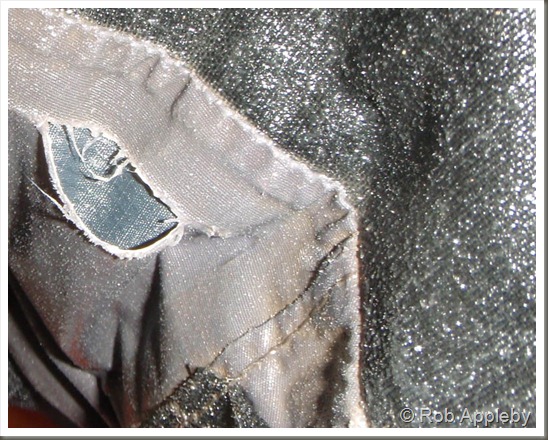
As I'd mentioned earlier I noticed the tear in my dry suit well into the trip, I was that amazed I took a photo!
OLYMPUS DIGITAL CAMERA

On closer inspection with the suit washed and dried this is what I saw. I've lifted the torn portion so it's more visible.

OLYMPUS DIGITAL CAMERA

The suit material had weakened along the taped seam, probably by chafing whilst walking or general movement on the kayak. As it had flexed along the length of the seam it had weakened through fatigue, some areas saw signs of external wear.

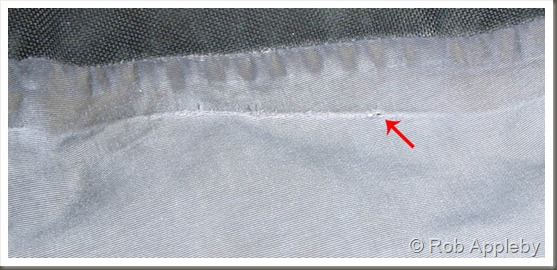
Looking at the same area on the opposite leg exactly the same problem was present. It's not something you'd notice because as the suit has aged the taped seams have become more visible. Hence an area of wear along a line is in fact very difficult to spot.
OLYMPUS DIGITAL CAMERA

The other leg had already holed in the same area, the hole was less than 1mm, though the fabric was weakened along the line close to it. I've macro'd in close, unless your inches from the damage you'd never notice it.

I went over the suit with a VERY close eye and more areas of damage became apparent. A very small hole was present along an area of slight wear, the wear line was an inch at most.

OLYMPUS DIGITAL CAMERA

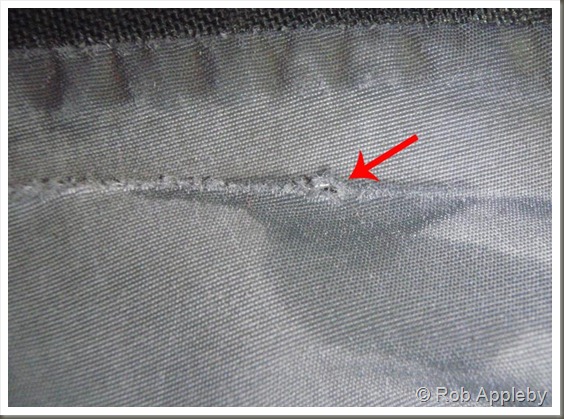
Again on the inside of the leg, a fussy join exists and the material is slightly rucked my the stitching. The whole length of this is around 1cm. A small hole around 1mm had formed where the material was raised by some stitching and had worn through.

OLYMPUS DIGITAL CAMERA

The same area on the opposite leg was showing similar wear though had not worn through.

OLYMPUS DIGITAL CAMERA

One final hole was found in the crotch area, again a very small length of wear, under an inch, though a tiny hole had formed.
OLYMPUS DIGITAL CAMERA

So there were four pinholes in my suit due to wear. They were all in areas you'd never notice and probably not really think to look. The worst area of wear had of course ripped. I'd not noticed it the previous 2 days, and with is close proximity to the centre hatch it was something that was easily spotted, so it's fair to assume the suit ripped on the day I noticed it.

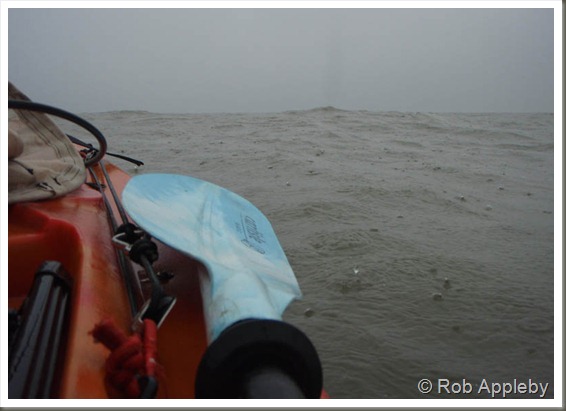
So, there I was sitting comfy in a steady rolling swell getting soaked in the rain. The camera is low here though the swell was at most 3'
OLYMPUS DIGITAL CAMERA

Looking at the camera memory card I'd taken several photos in the minute before I was tipped over. I was holding the camera when I capsized and apparently hit the shutter release a split second before I actually went under!. The kayak is at a 90 degree angle here, the rod holder is almost horizontal.
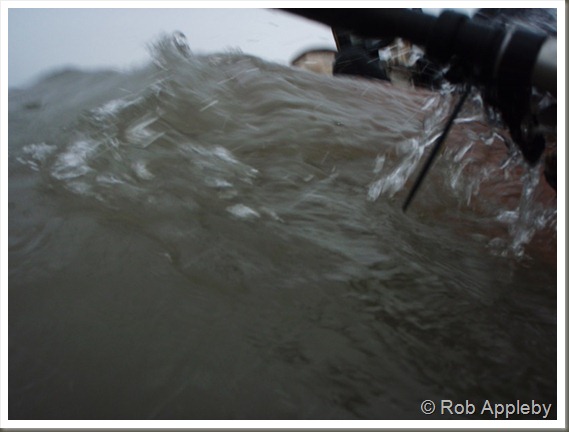
OLYMPUS DIGITAL CAMERA

Never let a bad situation stop you taking an interesting photo  Winking smile

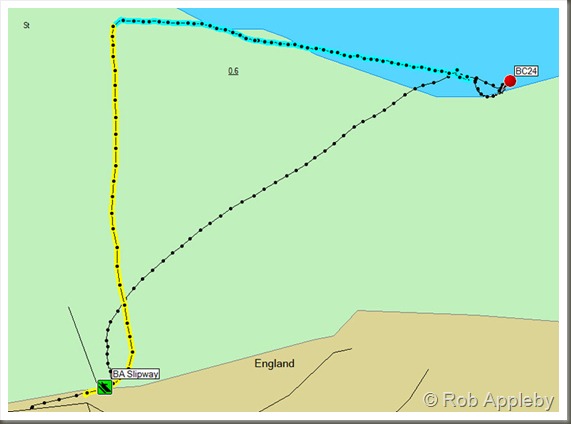
I capsized at 1428, the time was recorded on the photo. According the GPS I unclipped the anchor at 1430 and began to drift at an average on 1.1mph, bearing 285 degrees.

The RNLI picked me out at 1458 after a drift of just over 0.5 miles, they then headed for the Blue Anchor slipway. I'd been in the water 30 minutes, not the 35 minutes I'd thought. The black is my track out, the blue my drift post capsize and the yellow is the RNLI track to the slipway.
map

I was warm throughout, surprisingly warm and could have stayed in the water for a long time. Despite the damage to my suit my multiple layers of thermal clothing served me well. They did waterlog heavily and weighed a LOT once removed. However, the plan is not to get them wet in the first place !

The suit was 4 years old and had covered 200+ trips on the water. On inspection the suit was good condition and well maintained with new seals (talc'd after each trip), lube'd zippers, etc. However, if you looked VERY closely in areas that don't jump out, i.e high up on the inner thighs, crotch, etc, damaged had occurred, sufficient enough the cause the fabric to rip with little effort. You could lay that suit on the floor and check out the front, flip it, and check out the back, no damage whatsoever is visible. Yet it is worn and damaged, though it takes a VERY close and purposeful look to spot it.

So the lesson is don't just give your suit a cursory glance over post every trip, get up close and personal and give your suit a VERY close check-up, you may get a nasty shock!

Here's a link the the RNLI report, not totally correct, though close enough.
RNLI Report
