
I have a small dive reel that holds approximately 90m of 2mm cord which I use as my anchor reel. The photo below shows my current setup.
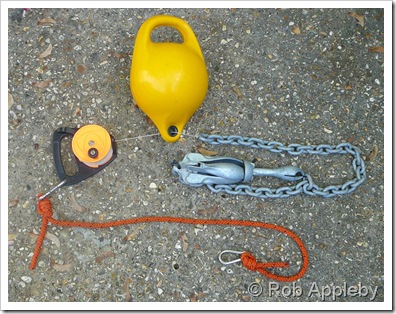
Due to the fairly strong tides that are experienced in the area that I tend to frequent, that tends to limit my maximum fishing depth to around 20-25m. That’s working on the theory that I let out three times the depth in anchor warp once the anchor has touched bottom. I.e, if I’m anchoring in 20m of water, I’ll let out an additional 60m to ensure I hold bottom in a strong tide. That’s 80m of warp for anchoring in 20m of water.
Most of my fishing takes place in 5-20m of water so my current setup has always proved more than adequate. However, in the summer I had an opportunity to fish the deep water lochs of Scotland in an attempt to catch a common skate. That trip didn’t materialise in the end, though I did prepare fully, which resulted in me producing an anchor reel suitable for deep water anchoring.
I’ve seen several setups over the past few months to cater for deep water anchoring, none of which seemed totally ideal, though they did what the owner required.
There was an article on a forum in which someone had purchased an electric fence reel for this very purpose. On the face of it, it seemed just about perfect, my only reservations being the all plastic construction of the item shown. Sure, it’s great for corrosion resistance, though I felt what with aging over time, and being under stress, it would eventually fail. However, the idea was still pretty sound, so I did a little more research and came up with a similar reel, albeit constructed a little heavier.

The spool is plastic and 8” in diameter and holds almost 300m of 2mm cord, suitable for all situations I intend to put myself in. There’s a locking brakes on the side, chunky enough to use with gloves and the reel locks solid. The bracket is steel, though plated to resist against corrosion. I stripped the reel and coated all the spindle and associated parts in a copper grease to give some lubrication whilst preventing corrosion in the long term.
One area of concern was the spool itself, or to be more precise, the lack of a line guide of some description. I felt that with the reel in the water, there was potential for line to spool off over the side and that would be far from ideal.
I visited the local supermarket and purchased a cheap stainless steel potato masher. After drilling out a couple of spot welds, removing the mashing head and then welding on a stainless ring from the local chandlers… I had a line guide. This was bolted onto the reel using the existing fittings.


I added some padding to the bracket in the form of a few layers of string, over the top of that I added some heavy duty heat shrink tubing. This had the result of producing a reasonably comfortable handgrip. Time will tell how this fares.
To the hand grip I added 4m of floating rope (removing the existing knurled knob left a perfect attachment point). This can be threaded through the ring on the anchor trolley and tied with a slip knot to the kayak lifting handle adjacent to the seat. A quick pull and the kayak is released from the anchor, leaving the whole setup in the water, though supported by the buoy to allow easy recovery to the anchor as required.
Adding up the coast of the reel, warp, rope, anchor, buoy, etc, the whole setup cost around £40, which I consider pretty good value!. Ok, it’s something that’s rarely going to be used, though it’s there ready to go should the need arise.


