I've returned from my third day of fishing/tuition and it's definitely an ongoing experience of ups and downs. I'm still working away on my Double Spey cast, it's certainly improved and I'm starting to cast a decent line, quite a lot of the time. That said, during the last hour of Friday I introduced something amiss into my cast and it all went wrong!. It didn't help that my hand were cold and I was probably getting a tad tired.
I finished on a coupe of decent casts, having decided that I was messing up the final stage. I'll get my ghillie/instructor to double check what I'm doing next Friday, though I think that I'm already on top of it...
It's certainly proving to be a challenge, which is what I wanted. When it's going well it's enjoyable and relaxing. Water levels were much higher this trip, partly due to meltwater, plus the hydroelectric at the dam had been activated. Water was deeper and faster, a different experience again from the previous week. Roll on Friday, I think I'm getting some tuition on the Single Spey cast, another thing to practice!
If I'm being honest I've only fished off the kayak 3-4 times in the past 5 years. Partially down to a lack of motivation, but also hindered by a temperamental back issue that can rear its ugly head when lifting/pulling heavy weights. The Hobie Outback, as much as it's a cracking fishing kayak, was just proving a bit too much.
Though it's more than that, when saltwater fishing in the UK there's quite some clothing required, add to that tackle, electronics, bait, etc. There's quite a lot of gear to organise for a trip, load/unload and wash/dry post a trip. I also found myself not feeling challenged anymore. I started my kayak fishing adventure in 2007, though ten years later I was running out of steam. I'd turned my hand to a few disciplines during that time, whilst achieving some competition success along the way.
I was fortunate to have been sponsored by Hobie, Lowrance, YakAttack and Reubon Heaton, though sponsorship perhaps proved to be a double edged sword, pushing me far more into competition fishing, freshwater lure fishing, video production/editing, gear reviews and promotion of my antics via social media platforms. I found that over time this detracted considerably from my enjoyment of the sport.
If I could turn back the clock I'd not entertain sponsorship, I'd have retained by Prowler Big Game kayak for much longer kayak, sticking to saltwater bait fishing, perhaps with a little saltwater lure action from time to time. I'm grateful for the opportunities that I've been given, and the experiences that they've bought, but allied with a back issue, my enjoyment of the sport faded rapidly during 2019/2020.
Though I still love fishing, I was keen to find something new, something challenging, I had zero qualms about starting at the bottom of the experience ladder again, in fact I embraced the notion.
The past five years has seen to move to, and around, Scotland. I've finally settled in the north, finding myself growing more intrigued with fly fishing as the months have gone by. I found the thought of river fishing quite exciting, always being on the move, wildlife and changing scenery to enjoy. Best of all, the gear is light and not much is needed!,.. my back approves.
I've recently purchased a house on the banks of the River Conon, Though I'm still awaiting to move at this point in time. I've met the local ghillies from that area and embarked on a 7 week course (1 day a week) introduction to fly fishing for salmon.
I've had to invest in some new tackle, not really a hardship as we all enjoy a bit of retail therapy where fishing is concerned. Lots of online research was conducted prior to committing to any purchases, allied with plenty of good advice from the ghillie who's teaching me the basics.
The Conon is a good sized river and produces good catches of salmon & sea trout on an annual basis. There's also trout fishing, which is probably something that I'll also pursue over time.
I ended up purchasing a Vision Hero fishing outfit, a 13'7" #8 rod with a matching Hero Salmon reel, loaded with backing, main line and an interchangeable tip (floating). I since purchased some additional tips (intermediate, sinking, etc) manufactured by Airflo, perhaps more on those when I get some experience with them.
Chest waders, wading boots and a wading jacket were also purchased, again, I may comment further on them once I've clocked up a few trips.
I've already enjoyed my first day of tuition, a rather chilly one at that!. Opening the curtains early that morning saw me greeted with a fresh fall of snow, though it gradually disappeared on my drive over to the Conon. It was nice to meet new faces from what's soon to be my local area, social life is a little lacking in my daily job, which often sees me working from home.
Post initial briefs and tackle up, I was soon heading to the river, breaking the ice by foot to access some clear water. I was introduced to the 'Double Spey' cast, which after some time I started to get to grips with, becoming more proficient as the day went on. It's all new, I wanted a challenge, well I was definitely getting that!!.
Lessons learned that day?, wear my artic socks!, my feet were definitely suffering in the frigid winter waters of the Conon. Post that trip I invested in a pair of Lifesystems Palm electric hand warmers, which I decided should prove very useful in future trips! (I hate cold hands). Though there was a log burner in the fishing hut, hot soup and plenty of coffee, hence plenty of opportunities to warm up throughout the day
I'll leave it at that for this entry. I think I'll have to tweak the title of my blog as my days of kayak fishing are likely over. However, the web address is well established and it's surprising how many daily visits that this blog still attracts. Hence I'll probably just introduce a fly fishing section and take it from there.
It's good to share experiences, I'm constantly reading other peoples pages, social media posts and watching YouTube videos, learning from others peoples experiences, good and bad, is very beneficial.
Well I first started kayak fishing back in September of 2007. Here I am twelve years later having just sold my kayaks with a view to throwing myself into a new hobby. What's that going to be?. Well, that's yet to be decided, though I'm trying to get into fly fishing. Covid19 hasn't permitted anywhere near the progress that I'd have liked to have seen, but I'm still hopeful!
I've hardly fished in the past 2-3 years. Back in the early days I'd clock up to a 100 trips a year, now I'm lucky to manage 4-5 trips. Why the loss of interest?. Well if I'm being entirely honest I could probably put it down to some aspects of sponsorship having changed my type of fishing. I'd always been a saltwater bait fisherman at heart, however, sponsorship seemed to push me more towards freshwater lure fishing and competitions which just weren't my cup of tea.
That said, I have some amazing memories to look back on and that's good enough for me!.
Thanks for all the follows and comments over the years, it's really been appreciated.
I'd hoped to get out a week earlier, though the forecast hadn't been favourable. As it happened the weather that week had been very good, typical!. With my Christmas holidays disappearing rapidly, I decided that I'd make an overnight trip to fish the muddy waters of the Bristol Channel. I was going to fish the waters off the Blue Anchor, located on the north Somerset coast, a place that had previously been my local area for a few years. However, I'd not fished there in 3-4 years, though the important question was whether or not the winter Cod fishing would be as good as I'd enjoyed in previous years.
It's a 3 hour drive westwards for me, though I'd packed the night before to make life a little easier. After quick coffee at 0600 I was on my way. I'd ordered my bait from Steve at Southwest Tackle in Watchet, the quality from there is always excellent. Despite having fished this venue many dozens of times, I couldn't remember how much bait I used to use on an average 5-6 hour session. I can now say that 1/2lb of lugworm and a couple of packets of frozen squid is about enough, yup, I had unwittingly purchased enough for 2 days. I had actually planned to overnight in the car and fish two tides, so if things had gone to plan this actually would have worked out ok. However, things rarely go to plan!
Since swapping to the Hobie Outback several years ago I've really struggled to store frozen bait like I used to on my old Big Game kayak. Back then I used to use a Flambeau box with ice blocks for this and it worked a treat. As much as I love my Dry Box it leaves no room for a suitable container for frozen bait. I don't like those soft coolbags at all, plus when I have used them I've either had to sit it on, or store it inside the front hatch. It's a far from ideal location, especially in a choppy sea.
I recently put together a 'double Flambeau box' setup that permitted dry storage for tackle, clothing and food as well as seperate dry storage for my frozen bait. Most importantly it fits very nicely into the tankwell area of my 2017 model Hobie Outback. Below is how it looked during the build stage.
It's very light and secures to existing strong points on the kayak. The boxes are physically joined with spacers, though I'll put a more detailed article up about this setup at a later date. Below is a photo of this combo-box rigged, ready for its maiden voyage.
I'm having to use the moulded in rod holders as there's no room to effectively mount rod storage tubes to this new box. Hence I'm effectively limited to two rods for this bait fishing configuration. Hopefully this won't prove too limiting as time progresses.
I'd purchased a rectangular hatch insert and added a divider using a section of nylon chopping board. This is screwed and glued into place, providing two watertight halves, ideally for keeping baits seperate as required. Below is a photo of the modified hatch insert and another of it loaded with bait prior to me launching. I'd previosuly had something very similar, though it had been sold with my old Outback.
In order to gain an extra 30-40 minutes on the water I decided to drag my kayak over the reef rather than wait for the tide to come over the mud flats. I'd forgotten just what an arduous task it was, though at least I was warm... very warm!
I headed out to my usual Cod fishing mark which put me onto an area of shingle. If you don't know the area well it's highly likely that you'll end up anchoring over mud and this has a dinstict effect on the species that you're likely to catch. Mud will consistently produce Thornback Rays, whereas fishing onto shingle tends to avoid them. The Cod fishing is generally much improved over the shingle, that's certainly my experience of this area over the years.
As can be seen in the above photo, the conditions were absolutely perfect!. It was rather cool at 1°C and the temperature never really rose above that throughout the session. After twenty minutes or so I dropped anchor and swung around into the tide. Baits were my standard Cod bait, namely lugworm and squid. I avoid using mackerel as it's way too attractive for the conger eel and rays, that said they will also take the squid, especially the eels. Though it does provide the best chance of hooking into a Cod. My rigs was a 6/0 Pennel using 80lb nylon. The heavy monofilament is fairly resistent to the small Conger that frequent the area.
Normally the eels have moved off into deeper water by this time of year as the water temperature falls. Previous years have seens the water temperature closer to 5/6°C, though this very mild winter is holding the water temperature at 9°C. This warmer water is far from ideal for Cod fishing plus it keeps the conger eels inshore.
The first half hour was rather quiet, though as the flood tide picked up the fish came onto the feed. The first fish was a strap conger of 6-8lbs,.... as were the next fifteen fish!. They're fun in the tide, though they weren't the target species. I did eventually have a bite that screamed Cod, a steady nod of the rod tip. Like an amateur I grabbed the rod and pulled into it, forgetting to be patient to allow the fish to mouth the bait for a little while. Well if it had indeed been a Cod, I missed it and there were to be no more chances.
I then hooked into something that felt different, a dogfish perhaps?. I really don't like dogfish, does anyone?. Though much to my surprise a Spotted Ray appeared next to the kayak. I've never caught one in these muddy waters before, the clearer waters further down the Channel can provide many, so this was a first for this mark.
As the tide slackened the fishing died off. I have had the odd big fish over slack water in years gone by, though it wasn't to happen on this session. The Whiting came onto the feed and for 20-30 minutes baits were swiftly removed the the hooks by these ravernous little fish.
This was my first trip with the new YakAttack Zooka2 rod holders. First impressions are good and I'll report back with a more detailed review in due course.
As sun began to set and the tide turned onto the ebb, a brisk wind started blowing from the East. The temperature plummeted and I soon lost the feeling in my feet. As the kayak swung about in the tide it also became ominously dark towards the North West.
I looked at my Iphone to check the weather. It was showing 60% charge and then the screen went black, it had switched off!. These lithium batteries do not like the cold at all. Without managing to get a weather update I could only go on what was happening around me and it wasn't particularly pleasant nor confidence inspiring. Despite having rigged my anchor light to allow me to fish safely into the dark, I decided to play it safe and headed back to shore.
Ah, the joys off landing back ashore with numb feet, I'd almost forgotten what it felt like!. I had planned to sleep overnight in the car, though it had become apparent during the session that I'd damaged my back whilst dragging the kayak across the reef. I certainly wasn't going to have a comfortable night in the car and it was highly unlikely that I'd be fit enough to fish the next day neither. I had some difficultly in de-rigging and loading the kayak back onto the car, so deciding to call it a day was a wise choice, a fact that was confirmed when I tried to get out of bed the next morning!.
I had a good chance to use my new YakAttack Zooka2's and Eagle Claw filleting knife, though I'll post a review up on both of those items shortly once I've another trip or two under my belt. That said this new filleting knife is a cracker, It's also my go to fish knife in the kitchen.
I'd left at 0600 and arrived back home at 2200, it'd been a long day. I had known in advance on this trip that the Cod were very thin on the ground. The water temperature really needs to fall and for that we need some wintery weather!. Unless the reports improve I'm not in a hurry to repeat this trip, it's a lot of effort. Though it was fun and I caught plenty of fish, no real complaints for my first trip of the year.
Well I've not posted anything for quite some time, not on my blog at least. I do post quite regularly on my Facebook page, though even that's been rather quiet as of late. I have been fishing, though there's been nothing exciting to report. The weather is unseasonably warm and the sea temperature is still too warm, certainly for the Cod. I recently had a trip over to Ireland that was sadly a bit of a disaster on various levels, though that certainly wasn't down to my host/guide and good friend Graham Smith.
I've been using the RAM 119 rod holders, both plastic and aluminium, since I started kayak fishing in 2007. I've tried a Scotty rod holder, though I just didn't get along with it at all. There's always been issues with being able to be sufficiently tighten down the RAM rod holders, some purchased items have been more effective than others. Though over time, wear and tear takes its toll and they become even less effective. Hence I decided to upgrade my rod holders after 11 years and that's quite a tall order.
I've been YakAttack Pro Staff for many years, since the beginning in fact, so it made sense to look there first for a suitable replacement. I know a few people who loved the original Zooka rod holder, though that's about to be updated in the very near future. The current offering is the Omega and Omega Pro, the latter having the addition of an extension arm. This arm is removable as required, hence purchasing the Pro provides the user with some flexibility as how best to use to rod holder to suit the type of fishing. It's been designed to be used to spinning reels, baitcasters, multipliers and even fly reels... perfect.
As I'm currently rigging a Hobie Outback Limited Edition (LE) for my son, I decided to purchase 4 YakAttack Omega Pro rod holders along with some extra GearTrac as my stocks were exhausted. That enabled me to replace my RAM holders on my own Outback whilst equipping his with the same setup. It just keeps everything simple and more importantly fully interchangeable. I've done exactly the same with the electronics, either kayak will take Lowrance units from the Elite upwards.
My biggest concern was strength, followed by adjustibility. I'd read somewhere that perhaps these rod holders were better suited to lighter rods, though having sat my saltwater outfits into these holders I'd definitely disagree. From previous experience I kind of expected these rod holders to be somewhat over-engineered and I wasn't to be disappointed. Any concerns I have may have had regarding their strength quickly evaporated after dropping a rod/reel combo into the rod holder.
Yakattack Omega Pro rod holder
I did have to remove the rotating locking ring to accomodate my larger outfits, though that's of no concern to me whatsoever, if for no other reason that my rods are always leashed. I was fishing with someone quite recently who refused to leash his rods, despite me offering him a leash for every rod his was using. After the first trip out he returned without a rather expensive rod/reel combo. Oddly enough he leashed his rods for the next trip!!!
So the Omega Pro is certainly strong enough for what I'd consider to be a medium weight saltwater outfit. With the extension arm removed (standard Omega rod holder setup) it's perhaps a littlemore rigid as you'd expect, though this comes at the cost of height. I guess it depends on your requirements.
The same Pro rod holder in 'Omega configuration'
I think that for bait fishing I'll perhaps use the standard Omega setup with the rod holders either side of the seat (armchair style fishing). If trolling, I'll mount them ahead of me with the extension arms fitted so I can use the extra reach to have the rods pointed away from the kayak, keeping the rod butts clear of the Hobie mirage drive.
Though what about adjustibility?. This is one area where the Scotty rod holders really disappointed, hence they never got used. The RAM holders had 'infinite' adjustibilty, though couldn't be reliably locked into position. The Omega rod holder is very effective!. It attaches to a length of GearTrac using the Lock n' Load feature, with the base being attached first with the use of an integrated MightyBolt (T-bolt). This takes but a few seconds and it can be left on the kayak with the rod holder removed... this is how I intend to use it. Notice that the base locks into the GearTrac so that it's unable to rotate under load, now that's a great feature.
The rod holder is attached to the base with a trigger system, depressing the trigger allows the rod holder to be raised and rotated into many positions before locking it back down with a push. Whereas lifting the same trigger allows the rod holder to be removed (watch the YakAttack video at the end of this post). Locking knobs on the extension arm allow it to be moved and locked solidly into several positions. It's certainly very adjustable!
Locking trigger on the base of the Omega rod holder
Adjustable Extension Arm (Omega Pro)
So there it is, the Omega Pro rod holder. I think that it's worth purchasing the Pro version just to gain the flexibility of the removable extension arm. I'm soon to take delivery of a pair of Zooka 2 rod holders so I'll be able to compare the Zooka 2 alongside the Omega... watch this space
Firstly I haven't caught one yet, in fact I've yet to try to catch one. However, I'd love to address that sooner rather than later, though it does fill me with a rather large amount of trepidation!. Personally, I think you have to be somewhat mad to attempt to tackle such a large fish from a kayak, a large fish with with big teeth!.
That said my good friend Graham Smith has gone and done it again, catching yet another large Porbeagle Shark from his kayak. He's based in Ireland and has access to some superb fishing.
Well the 'old' 2015 loan Hobie Outback is due to depart to a new owner on Saturday with my new replacement 2017 model due to arrive at the Hobie UK dealer the same day. However, I probably won't be able to collect it until later next week so that's provided me with time to consider how I'm going to rig it and what exactly I'm going to have to order. Hopefully it'll look just like this one below when I collect it.
This Outback will have to last many years, I'm not going to be in any rush to upgrade to the latest model, etc. Rigging is expensive and time consuming, plus every time I move onto a new kayak I end up losing quite a lot of money on items that can't be removed, items such as track systems, fixed mounts, anchor trolley, hatches, electrical looms, etc. It's also the time required to actually rig the kayak, giving it plenty of thought, as well a taking the time to produce a top notch final product,.. this all takes time. A considerable amount of time!
I considered fitting Hobie H-Rails plus the associated accessories, though it just starts to get more complex and more expensive. Plus I was concerned about re-entering the kayak after a capsize, etc. I justed to keep it clean and relatively simple.
I've rigged two Outbacks since 2012, some things have worked well, other modifications perhaps haven't been quite so successful. There are certain things that are 'must have' modifications, these will include:
1. An anchor trolley. I've previously made my own anchor trolleys on two of my previous kayaks. It's straight forward and not particularly expensive. However, this time I'm planning on fitting a YakAttack LeverLoc system, probably one on either side. It looks to be a well thought out, innovative, yet simplistic system, made from quality components, Time will tell, my YakAttack order is due to arrive shortly.
2. Rod holders (I'll stick with my trusted RAM tube setup for bait fishing). I've been using RAM RAP-119 rod holders for some time now. I've modified mine specifically for the Outback and they work well for most applications.
3. Rectangular hatch. Storage space is everything on the kayak for me and the standard round hatch just doesn't cut it. I'll also add the tackle insert as well as an integrated dry bag within the hull to provide a large amount of enclosed dry storage. I've done this previously and it works very well.
4. Combination fish finder/GPS. I've watched this technology improve exponentially since I started kayak fishing in 2007, starting out with a Humminbird 565 to my Prowler Big Game. I'm fortunate to be an Ambassador for Lowrance and my most recent setup is an HDS 9 Carbon with TotalScan, This should be a straightforward installation as Hobie kayaks are 'Lowrance ready'.
5. Accessory Mounts. Whether it be rod holders, fish finders, navigation lights, cameras, etc, they all need a way of being mounted to the kayak. I prefer a universal type of system and for this I've been using YakAttack's GearTrac from the beginning. These can accept a variety of fittings and are ideal for mounting a multitude of accessories. The latest 2nd Generation GearTrac is somewhat lighter and will be a new fit for myself.
6. An electrical system. To me this is vitally important, not just because it's require to power up the FF/GPS and navigation light, etc, but it also has be be extremely durable to survive many years in a saltwater environment without failing. This requires quality components as well as a methodical approach to ensure watertight integrity is maximised. For this I use Bulgin Standard marine connectors. They are very well sealed and feature stainless steel pins and sockets. Looms are covered with heat shrink tubing for durability and ssuitably sealed. This is not a cheap setup, however it's tremendously reliable.
7. Power supply. Over the years I've used SLA batteries to power up my electrics. In the early days I could get a couple of sessions out on a 7ah battery if needed. Though with today's large screen combination fish finder/GPS units the power requirements are far higher. With my latest Lowrance HDS 9 Carbon I was really struggling to get a decent fishing session out of a 12ah battery. Lead acid batteries are bulky and heavy so after much research I've recently moved away from SLA batteries and purchased an LiFePO4 (Lithium Iron Phosphate) battery. Despite being 22ah in capacity, its lighter than a 12ah SLA battery and comparable in size. It's charge from flat to full capacity in 4 hours, that's seriously fast compared to a lead acid battery. This is stored in its own dry bag with a fully waterproof connector within the kayak.
That's the 'must have' items for the Outback, though there are other considerations as well.
As much as I never got to sail the 2015 Outback, I did sail my first Outback model on quite a few occasions and enjoyed it immensely. To that end I'll rig this new model for sailing from the outset. That'll require the crossbar for the Hobie Sidekicks to be fitted as well as some minor items of hardware towards the front hatch.
The tankwell area will be used for my drybox/ Hobie H-Crate or Hobie Livewell as required, nothing new there whatsover, it works, no need to re-invent the well.
Visually this new 2017 Outback will look very similar to my current setup, though it'll be mine and that just feels better for a variety of reasons.
I think that should do it. It'll take me a good couple of days to get it rigged just how I want it. Time to order up some items so I can crack on with the rigging in a week or so, hopefully the YakAttack items will arrive in good time. I want it to be fishing ready within a fortnight, bring on the fishing!
I’m currently using a 2015 Hobie Outback for my main fishing duties as well as a 2015 Hobie Adventure Island for both sailing and fishing. The AI is mine, though the Outback has been on loan from the Hobiecat Centre in Poole, Dorset. As much as this has been a great arrangement, I’ve decided to go back to private ownership for a few reasons, nothing sinister I hasten to add.
The choice was simple, another Outback (Red of course)!. I did briefly consider the other Hobie options, no other brands interested me as I’m now a pedal convert. The Outback is still the obvious choice of Hobie kayak for fishing duties due to its stability, roominess, rigging options and ease of sailing.
Are there any difference from my current 2015 model?. There’s only one thing really, though it’s a big thing!… the Mirage 180 drive. It’s offers full power in both directions, yup, I will be able to select reverse!!. For open sea fishing that may be somewhat limited in its use, though for freshwater in rivers and lakes it’s going to be extremely useful.
As for rigging, well it’s going to be more of the same, though I’m going to rig it up with YakAttack’s LeverLoc anchor trolley and their 2nd generation GearTrac. I’ll be swapping over my Lowrance Carbon 9 combo fish finder/GPS, outriggers (Hobie Sidekicks), etc. I’m not going to rush into rigging for a couple of weeks, this kayak will be with me now for many years so I want to get it right first time.
Underwater video is not really something that I've tried as such, though I do enjoying watching some of the video clips that have been produced over the past year or so. Daniel van der Post has produced some excellent freshwater lure fishing video clips and Graham Smith has produced some really interesting saltwater footage covering several methods.
Here's his latest clip of a Thornback Ray taking a bait. Just superb!
I purchased a Savage Gear Pro XL landing net the other week. I've been using a rubberised landing net (50cm) that I bought from Bass Pro a few year ago, though it's too far small for large Pike, etc. When it arrived (Ebay purchase) is seemed horrendously large. Even with the extendable handle collapsed, the handle was excessively long and too unwieldy for kayak use. I was actually that put off that I left it at home for my last trip, the trip where I hooked a PB Pike and lost it due to the lack of a large landing net!!.
I did take it along for the next trip, though the one time that I tried to use it it was a complete pain in the butt, taking way too long to unfold the net and extend the handle. What I needed was the net already unfolded , though without a one metre handle (minimum) attached to the net. I finally got around to having a look this weekend. Below is a photo of the net unfolded with the handle extended. Obviously I'd not have the net configured this way for kayak use, but it gives you an idea of it's size. Handle length varies from 1.0m to 1.8m.
The handle needed to go!. It is locked into position using two push pins, disengaging them both at once is a tad fiddly in itself. The extendable handle is locked to the desired length using a screw fitting, this same fitting can me unscrewed fully in order to remove the inner extendable section.
With the handle split, the larger diameter section is all that's required. It is removed by depressing both locking pins and orientating it such that the handle can be slid out from the net itself. This can then be cut down to whatever length suits the user best. My rod holders are about 12" deep on average, so I chose to have a usable handle length of approximately 13". It was a simple case of hack sawing the handle to length and fitting a rubber end cap (I had one handy).
With the cap fitted it was simple a case of re-fitting the handle. I also took the opportunity to fit a '4lb' float to that I purchased a few years ago in Florida to the base of the net, close to the handle. I may also fit a simple leash in due course, though for the moment the aim had been achieved.
The overall weight of the net has been lightened considerably and its usability can been dramatically increased. The long handle has now gone, with a short lightweight item in its place. The net can remain fully deployed, either in a rear rod holder or draped over the front hatch. It's just far better. As I had the float and handle grip lying in my box of spares, the modification cost me nothing whatsoever. It may seem a little odd taking a hacksaw to a brand new £50 landing net, but it's changed it from a somewhat impractical item to something that is very usable.
It's been three weeks since I posted a report covering my fishing trip to Wraysbury Lake. When the opportunity arose for another trip I grabbed it, quite eager to try my luck at catching another large Pike, perhaps even the elusive Perch. I say that the Perch are elusive, though it's probably more down to the fact that bar a couple of tiddlers that I'd caught previously, I'd not actually seen a Perch of note in the flesh so to speak.
The plan had been to meet up with Ian Harris and David Morris to fish both days over the weekend. The weather forecast wasn't exactly favourable, though the margins are generally quite heavily wooded so there's generally always shelter to be found. I was already fairly organised, or was it more a case that I'd not really unpacked from my previous trip?
It was also an opportunity to test out my new LiFePo4 (lithium iron phosphate) battery, a whopping 23ah that I deemed necessary to power my Lowrance HDS9 Carbon combo FF/GPS unit. Though my HDS7 Gen 3 was also killing off my 12ah SLA battery in any session over 6 hours. These big display units are actually very nice to own, though there is one big cost.... current draw!. However, I'll look more at batteries in a later article.
The alarm went off at 0600 and by 0745 I'd hit the road having already loaded the kayak and consumed a large coffee. It's an hours drive to the Wraysbury complex for me, quite a pleasurable one at that time of the morning. It was a different lake to what I'd previously fished and it certainly looked interesting, what with numerous islands and a few backwaters, there was plenty to fish or just to explore!. I'm not sure what time we launched, probably by 0900, though how I'd love to slip into the water there at 0630.
I'd had a look on the Insight Genesis webpage to check if the lake had been previously mapped. Sadly there was nothing, so I planned to map as much as the lake as reasonably possibly during the session. I had actually hoped to utilise Navionic's SonarChart Live, though it transpired that my Navionics Gold card didn't offer that facility. I do have a more up to date card in the post, however, using this feature will have to wait until at least my next trip. Creating your own charts on the go?, that has to be a good thing... watch this space.
I do like fishing alone at times, just enjoying a venue, the time of the morning, etc. Once launched I headed around the corner into quite a large bay. I trolled the margins a couple of times and then covered the remainder of the bay casting methodically. Third cast saw me hook up into a fish!. It was a 'jack' pike of 3-4 lbs, no complaints as it meant that at least I wasn't going to blank!
I did try to get a decent photograph of my first fish of the day, though it didn't want to wait about...
I caught three fish in quick succession, all a very similar size. All were taken on a Fox Rage Pro shad mated to both 10g and 15g jig heads. I find the 15g ideals for trolling in depths of up to 5m with the 10g ok for casting, perhaps even a 7g would work just as well. Though they are quite prone to damage and the two I had with me became somewhat unusable within a couple of hours.
I'm sponsored by Lowrance so I'm somewhat spoilt when it comes to electronics. This day I had the latest HDS9 Carbon fitted. It has a 9" screen and this enables me to split the screen into three sections with ease. As I was mapping the lake I chose to have a map overview displayed along with Broadband sonar and StructureScan . As much as I didn't have a usable chart loaded, it enabled me to see what areas of the lake I'd covered. Helpful both in mapping and ensuring that I'd potentially covered all fish holding areas (note the left section of the display below).
What there is as this venue is an abundance of wildlife, I spend probably too much time listening to the variety of bird calls and try to locate the various species in the tree tops. Am I a closet 'twitcher' ?.. perhaps. Though I did enjoy watching a pair of Red Kites for almost an hour, very graceful birds. I left the bay and headed along a narrow stretch of water. I was regularly getting brief hits to my lure, the number of failed hook-ups was numerous to say the least. Small Perch or Pike no doubt, both frustrating and entertaining at the same time.
The fish kept on coming, though they were generally quite small in size, feisty though!. Like most anglers I do at times lose a little too much tackle. I can go weeks without losing something, then lose 7-8 lures in a session!. It's always nice to get a little payback, so when I spotted a lure in a nearly tree I couldn't let it remain there.
I have to admit that today did not result in many notable photographs. I caught a nice double figure Pike and it gave quite a memorable fight. It was eventually netted and quickly unhooked, ready for its photo call... it had other ideas (again!).
So I can catch fish, just not photograph them apparently. It seems that it's safer to photograph them in the net first... here's a Pike in the net :)
The fish just kept on coming, here's another one...
I'm often asked about using Side Scan sonar (Lowrance StructureScan), is it worth it?. Well traditional broadband sonar, even down imaging, covers only a small area of the water beneath the kayak. Yes, the deeper the water the greater the coverage, though in reality that area is still very small. Being able to look 15-25 metres either side of the kayak with ease?, well that's somewhat priceless. It's possible to pass directly over a featureless bottom whilst being totally ignorant to both fish and structure that may exist either side of the kayak. Look at the screenshot below:
The traditional broadband sonar (top right) is showing a rather featureless bottom, increasing in depth over time. Though look at the StructureScan directly below. To the left are several raised areas of terrain though to the right it's somewhat bland. Well how does this help?, turning around and heading back a few metres off to the left will put you onto potentially fish holding structure. I cant see any fish on that particular screen shot though it doesn't mean that there are none there. I used this method many times throughout the day and it provided me with hook-ups on several occasions.
How do fish appear on the StructureScan?. Well that depends on various factors including fish size, water depth as well as there's position relative to the sonar (i.e beneath or off to one side). Below are a couple of images of what I'm talking about. The first picture below shows a shoal of Carp pretty much directly beneath the kayak. They are clearly visible to the left of the display on the Broadband sonar as large 'fish arches'.
Though on the StructureScan display to the right (above) they are clearly visible towards the bottom of the water column (even Carp shaped!) as well as some shadows off to the right created by fish. Shadows?, sonar like light will create shadows due to being unable to pass through an object. It's not terribly clear on the image above, though how about this image below?
There are clearly two fish (white marks) about 9 metres to the left of the kayak, now several metres behind the kayak. As they are off the bottom they are casting a 'sonar shadow' immediately to their left and can therefore be confirmed as fish. This shadow can be used to provide an idea of the depth of the fish. Also, note the methodical mapping track. Parallel tracks to ensure total coverage. It also helps to cover all possible fish holding areas to a good degree.
I actually targeted those fish above by tapping on the display on the HDS9 Carbon and selecting the 'GOTO' option. I was steered directly back towards these fish as can be seen below to the left of the screen. Out of interest you can also see another large fish on the broadband sonar below (top right) lying hard on the bottom at around 4 metres, seen whilst navigating back towards the two fish I highlighted on the StructureScan... fish everywhere!
That fish above that's lying hard against the bottom was most likely a Pike. With the water temperature so cold these fish are lying deep in the water, a clue being the leeches that are attached to pectoral fins of the fish that are caught during the colder months, this can be seen below.
These end up littering the kayak after a few fish, it's become pastime to locate them and ditch them overboard during those quieter moments.
With my two fox lures destroyed it was time to try out my new collection of Westin lures. I'd previously had some great success with the Westin Shad Teez (below), not doubt very effective due to its famous rolling action. Sadly my only 'Crazy Deal' colour Shad Teez had been chewed up beyond recognition so I decided to try another Westin lure from my box.
Out of the box came my one and only Hypo Teez, well in this particular colour scheme (below).
I mainly trolled this lure and it was smashed in the first 10 seconds!, trust me, that builds your confidence in a lure VERY quickly!. It took many Pike during the session and it showed very little wear considering the abuse it took. It doesn't possess the rolling action of the Shad Teez, though the paddle tail creates very effective movement. I'll certainly be adding several to my collection, though I'll also use them with 7-10g jig heads for casting purposes, especially into shallower water.
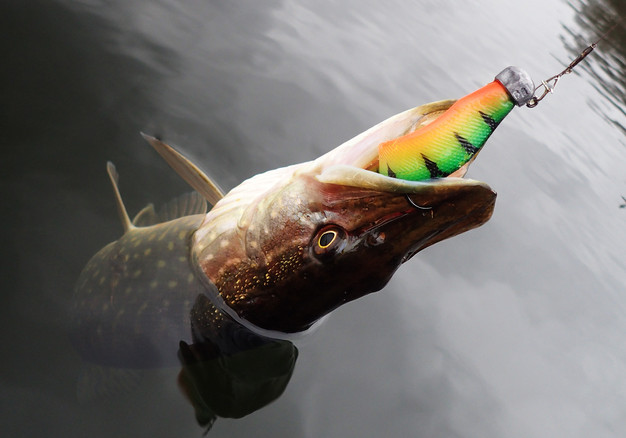
As mentioned, the Hypo Teez was killing the Pike out in the lake (not literally!). Below is what became a common occurrence... an 'inhaled' Hypo Teez. At times unhooking required forceps. Note the lure clip!!!!. I'd had problems with the clip on the previous fish. False economy for sure. Next time a lure clip shows signs of damage it gets changed. Last thing you want to do is lose a great fish or leave your lure in the mouth of a fish.. best avoided wherever possible.
The hunt for Pike continued and there was no shortage of them. I stopped keeping count at fifteen, though I caught a few after that as well. Despite the sheer number of fish my best had topped out at around double figures. However, the was eventually to change as I hooked up into the 'beast'.
This fish stayed deep for some time before I managed to lift it off the bottom and bring it up towards the kayak. It still had plenty of life remaining even then, stripping line from the reel as it so wished.
Point to note - Two days earlier I'd taken deliver of a new XL Savage Gear folding landing net. It seemed huge compared to my Bass Pro scoop net which is 50cm long so I made the decision to leave it at home.
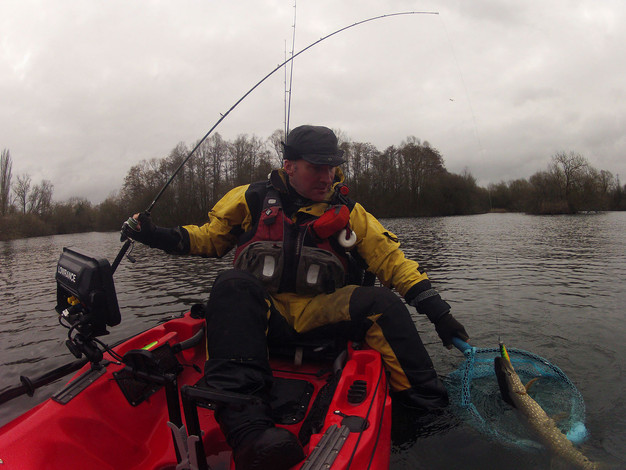
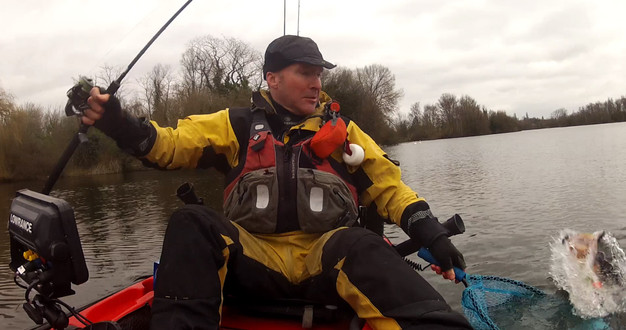
The fish surfaced and it was far bigger than I'd expected. I knew it was a decent fish, but no, this was a very big fish. I could see that it was very lightly hooked (in the cheek) so I didn't want to put excessive pressure onto it by bringing it next to the kayak to hand lift out. Despite knowing the net was too small I had a plan. Get its head into the net and somehow grab its tail and bring it aboard. Well that was the plan......
Below is a video of the result.
Yup, it was very painful. I did regret leaving that nice new big Savage Gear landing net at home... several dozen times in fact. That said, its handle is way too long and I don't want to have to pull out the handle each time, it needs modifying for kayak use.
Though that decision did cost me what was probably my biggest ever Pike.... what could have been.
I wont lie, I was feeling rather glum for at least 10 minutes. A packet of Jaffa Cakes later and moral was mostly restored. Ok, I'm lying, I was gutted for several hours.
I continued to map and fish the lake. It proved to be fairly featureless in the deeper areas, bar the odd bank and depression here and there. Though I did pick up a large area of rough ground several metres off to one side (thank you StructureScan) so I cast a lure in that direction. After allowing it time to sink i started a slow retrieve. Literally 3-4 seconds into the retrieve it was smashed and it didn't feel particularly 'Pike-like' .... and it wasn't!.
It turned out to be a cracking Perch which slipped very nicely into my 50cm Bass Pro net!. I don't think it was my biggest Perch (currently 46cm), though as I didn't take a measuring board I'll never know. It was back in the water within a minute, quickly unhooked, a flurry of photos before watching it plunge back down into the muddy depths.
Catching that Perch certainly eased the pain of having lost that big Pike an hour earlier and it was a really great way to wrap up a cracking session afloat. Ok, I said that I'd stopped counting at 15 Pike, 18 was the final count, plus a nice big fat Perch!
The LiFePo4 23ah battery was still holding 60% of its charge after the 6+ hour session. That's well on target to it's expected 13-15 hour life that I'm expecting for the HDS9 Carbon FF/GPS or over 25 hours for the Elite 7 Ti. That's pretty awesome, I could use the Elite 7 Ti for a long weekend away on one charge. That said, a full charge only takes 4 hours, that's super quick by SLA standards.
If you'd like the chance to kayak fish at the famous Wraysbury Lake complex why not come and join me and many other kayak anglers at the London International Kayak Fishing Festival. At £40 for the 3 day lure only predator competition, including camping, it's going to be a very special event. Put the dates in your diary: June 9-11th 2017